Differentiation of the trigonometric functions is the technique of determining the derivatives of trigonometric functions. In other words, finding the rate of change of a trigonometric function with respect to a variable is the differentiation of trigonometric functions. The differentiation formulas for the six trigonometric functions can be applied in a variety of derivative application issues.
The sine (sin x), cosine (cos x), secant (sec x), tangent (tan x), cotangent (cot x),and cosecant (cosec x) are the six basic trigonometric functions. The derivatives of trigonometric functions will be discussed in this article. Differentiation of trigonometric functions has applications in a variety of domains, including electronics, computer programming, and cyclic function modeling.
Differentiation of trigonometric functions is a mathematical procedure that determines the rate of change of trigonometric functions with respect to a variable angle in trigonometry. The quotient rule can be used to differentiate trigonometric functions using the derivatives of sin x and cos x. The following are the differentiation formulas for the six trigonometric functions:
Now Let us Proof the Derivatives of Trigonometric Function:
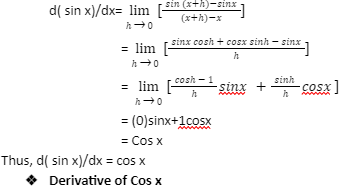
We’ll use the first principle of differentiation to find the derivative of sin x, which is the definition of limits.
We know that: sin (P+Q) = sin P cos Q + sin P cos Q
Now let us Differentiate the trigonometric Function, Sin x.
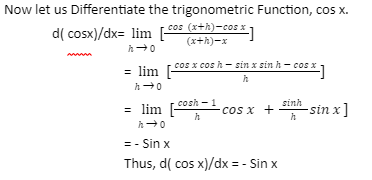
We’ll use the first principle of differentiation to find the derivative of sin x, which is the definition of limits.
We know that: cos (P + Q) = cosP cos Q – sin P sin Q
Now let us Differentiate the trigonometric Function, cos x.
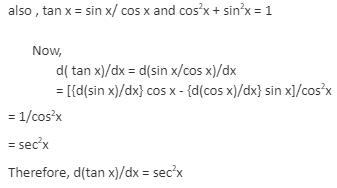
Derivative of Tan x
Using the quotient rule, we’ll find the derivative of tan x. To calculate the derivative, we’ll use the basic trigonometric formulas and identities;
We know that, d( sin x)/dx = cos x and d( cos x)/dx = -sin x
Similarly we can also prove the differentiation of other Trigonometric Function.
Differentiation of trigonometric functions has a wide range of applications in mathematics and in everyday life. The following are a some of them:
Differentiation Can also be used to


 Profile
 Settings
 Refer your friends
 Sign out