An angle is a figure generated by two rays or lines that have a common endpoint in Plane Geometry. The name “angle” is derived from the Latin term “angulus,” which means “corner.” The two rays that make up an angle are called sides, and the shared endpoint is called the vertex. The angle in the plane does not have to be in Euclidean space.
Angles formed by the intersection of two planes in Euclidean or other space are called dihedral angles.
Positive Angle: If the angle is in opposite direction in which a clock moves , then it is called a positive angle.
Negative Angle: If the angle is in the direction in which a clock moves , then it is called a negative angle.
Geometry is a branch of mathematics concerned with the measurement of shapes. It also emphasises the relative arrangement of the forms as well as their spatial characteristics. We all know there are two forms of geometry: 2D and 3D. Points, lines, rays, and flat surfaces are used to create all geometrical shapes before being divided. When two lines or rays converge at a single place, the measurement between them is called an “Angle.”
The angles can be labelled in two distinct ways. They are as follows:
Method 1: Give the angle a name. Generally, the angle is denoted using lower case letters such as “a,” “x,” and so on, or with Greek letters such as alpha (α), beta (β), theta (θ), and so on.
Method 2: We may determine the angle by using the three letters on the shapes. The vertex should be the centre letter (actual angle).
for instance, ABCis a triangle. We can write ∠BAC = 60° to signify the angle A is equal to 60 degrees.
Angles are usually expressed in degrees (°). A “protractor” is an important geometrical tool for measuring angles in degrees. A protractor is a device that has two sets of numbers that are pointing in opposite directions. The outer rim of one set goes from 0 to 180 degrees, while the inside rim of the second pair goes from 180 to 0 degrees.
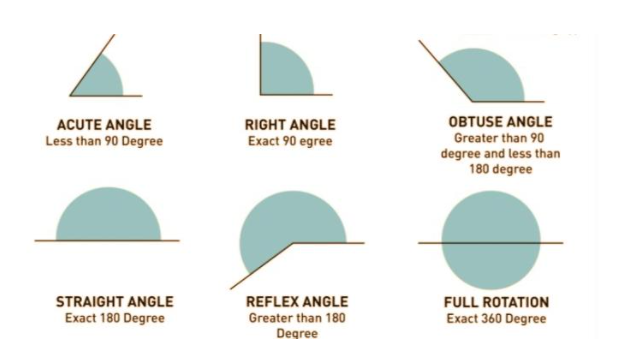
Angles are categorised into the following categories:
It is further classified into numerous sorts based on these angles and lines, including complementary angles, supplementary angles, adjacent angles, vertical angles, alternate interior angles, alternate exterior angles, and so on.
When the transversal cuts two or more lines, it creates a series of angles. The pair of angles is given a name that is determined by the angle’s position in reference to the lines. There are two types of lines: parallel and not-parallel. The following are a few examples of important pairs of angles:
Corresponding Angles
Let’s look at some of the most important theorems about lines and angles:
Angles have the following key properties:
The 6 types of angles are right angles, acute angles, obtuse angles, straight angles, reflex angles, and full angles. i.e


 Profile
 Settings
 Refer your friends
 Sign out