Hydrogen peroxide is a frequently used chemical compound used as a cleanser by numerous surgeons and homemakers. This substance is volatile and is denser than water in its pure form.
Combined with 2 molecules of oxygen to form hydrogen peroxide, the compound’s chemical formula is H2O2. The substance is the most straightforward peroxide available (oxygen-oxygen single bond), having basic uses as a bleaching agent, oxidizer, and antiseptic.
The substance, also known as high-test peroxide, is a pale blue and clear liquid also used as a propellant in rocket engines in concentrated form.
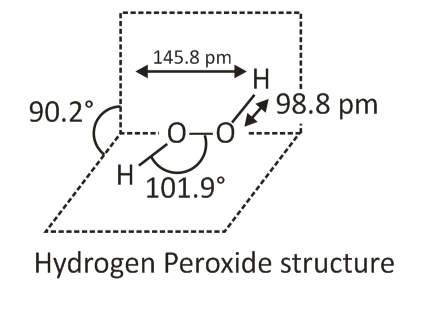
The structure of hydrogen peroxide is non-planar. There are 2 planes, and each plane has one O-H bond. The angle between the planes is 90.2o. Plus, the bond length is 145.8 pm, and length of the O-H bond is 98.8pm.
It proves the valence shell electron pair repulsion theory correct as each oxygen atom contains 2 lone pairs of electrons. The unbonded electrons of oxygen are repelled by hydrogen atoms leading to forming the bent molecular shape.
Hydrogen Peroxide can be prepared by 3 methods. They are described in detail here.
Hydrogen peroxide can be prepared from barium peroxide. Removing excess water by the process of evaporation under reduced pressure, while acidifying barium peroxide, is one of the ways to obtain a chemical compound named hydrogen peroxide. The statement can be justified with the help of a reaction mentioned below:
BaO2.8H2O(s) + H2SO4(aq) → BaSO4(s) + H2O2(aq) + 8H2O(l)
The only limitation of preparing H2O2 through barium peroxide is that the solution contains many Ba2+ ions that catalyze the decomposition of hydrogen peroxide. This does not let the substance to be stored for a very long duration and makes it unstable and excessively explosive. As a result, it is preserved in a water solution when prepared from the laboratory method.
Hydrogen peroxide can also be produced through the auto-oxidation method.
Merck’s preparation method: We get the mixture of hydrogen peroxide and sodium sulphate by adding sodium peroxide to a cold solution of 20% sulfuric acid. At the same time, cooling the crystals of sodium sulphate and separating the solution results in obtaining 30% hydrogen peroxide.
Na2O2 + H2SO4 → Na2SO4 + H2O2
Many industries prepare the substance by electrolysis of 30% ice-cold sulphuric acid. We get the peroxodisulphate when the acidified sulphate solution is electrolyzed at an extremely high current density. When the peroxodisulphate is hydrolyzed, hydrogen peroxide is obtained. The following reaction will help you understand how it is done:
2HSO4-(aq) [Electrolysis] → HO3SOOSO3H (aq)
HO3SOOSO3H(aq) [Hydrolysis] → 2HSO4- (aq) + 2H+(aq) + H2O2(aq)
Reaction: 2H2O2鈥(aq)→2H2O(l)+O2(g)
Reaction: 2FeSO4+H2SO4+H2O2→Fe2(SO4)3鈥+H2O
Reaction: PbS(s)+4H2O2(aq)→PbSO4(s)+4H2O(l)
Reaction: NaNO2 + H2O2 → NaNO3 + H2O
Reaction: Na2SO3 + H2O2 → Na2SO4 + H2O
Reaction: Pbs + 4H2O2 → PbSO4 + 4H2O
Reaction: Ag2O + H2O2→ 2Ag + H2O + O2
Mentioned below are the multiple uses of hydrogen peroxide:
Hydrogen peroxide is a frequently used chemical compound by surgeons and homemakers. It is a volatile substance and is denser than water in its pure form. Due to its unique chemical and physical properties, hydrogen peroxide is used widely in industrial, commercial, and laboratory applications.


 Profile
 Settings
 Refer your friends
 Sign out