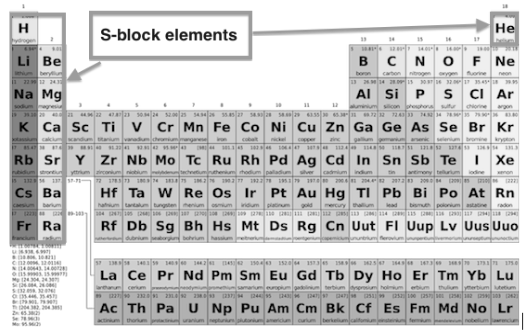
The s-block elements that have only one electron in their s-orbital are called group one or alkali metals, whereas the s-block elements that have two electrons filling their s-orbital are called group two or alkaline earth metals.
The electrons in an atom occupy various sub-orbitals of the available energy levels in the order of the increasing energy. The last or the outermost electron may be present in the s, p, d, or f subshells. In this way, elements having their last electron in the s-subshell are called s-block elements.
The following is the general electronic configuration:
Alkali metals: ns1
Alkaline earth metals: ns2
Element | Symbol | Electronic configuration |
Lithium | Li | 1s22s1 |
Sodium | Na | 1s22s22p63s1 |
Potassium | K | 1s22s22p63s23p64s1 |
Rubidium | Rb | 1s22s22p63s23p63d104s24p65s1 |
Caesium | Cs | [Xe]6s1 |
Francium | Fr | [Rn]7s1 |
Element | Symbol | Electronic configuration |
Beryllium | Be | [He]2s2 |
Magnesium | Mg | [Ne]3s2 |
Calcium | Ca | [Ar]4s2 |
Strontium | Sr | [Kr]5s2 |
Barium | Ba | [Xe]6s2 |
Radium | Ra | [Rn]7s2 |
2M+H2O → 2M+ + 2OH– + H2
Reason being that they can only lose one electron from their valence shells.
The following are examples of s-block elements of group 1:
Be2+ > Mg2+ > Ca2+ > Sr2+ > Ba2+
M+H2 → MH2
The following are examples of s-block elements of group 2:
The s-block of the periodic table comprises Group 1 (alkali) and Group 2 (alkaline earth) metals. Since their oxides and hydroxides are alkaline, these are called s-block elements. They can be differentiated by the fact that the alkali metals have one valence electron and the alkaline metals have two valence electrons. These are highly reactive: alkali metals form monopositive ions, whereas alkaline metals form dipositive ions.Both types of metals have nearly the same type of chemistry. However, some differences arise because of reduced atomic and ionic sizes and increased cationic charges in the case of alkaline earth metals. The industrially essential compounds of calcium are calcium oxide (lime), calcium hydroxide (slaked lime), calcium sulphate (plaster of Paris), calcium carbonate (limestone), and cement. Portland cement is an important constructional material. It is manufactured by heating a pulverised mixture of limestone and clay in a rotary kiln. The clinker that is thus obtained is mixed with some gypsum (2-3%) to give a fine powder of cement.The alkali metals are silvery-white, soft, and low melting. They are highly reactive.


 Profile
 Settings
 Refer your friends
 Sign out