In the shell atomic model, an atom’s electrical configuration can be described by listing the number of electrons in each shell, starting with the first. The 11 electrons in sodium (atomic number 11) are distributed as follows: the K and L shells are totally filled with 2 and 8 electrons, respectively, while the M shell is only half filled with one electron.
In the quantum-mechanical concept, an atom’s electronic configuration is expressed by listing the occupied orbitals in order of filling, with the number of electrons in each orbital indicated by a superscript. The electrical configuration of sodium in this notation is 1s2 2s2 2p6 3s1, which is dispersed in the orbitals as 2-8-1. The electrons in excess of the noble gas configuration immediately preceding the atom in the periodic table are frequently listed using a shorthand manner. Because sodium (chemical symbol Ne, atomic number 10) has one more 3s electron than the noble gas neon (chemical symbol Ne, atomic number 10), its shorthand notation is [Ne]3s1.
We must follow three rules when assigning electrons to orbitals:
The ground state electron configuration in atoms/ions with two or more electrons (1) minimizes the total energy of the electrons, (2) follows the Pauli Exclusion Principle, (3) follows the Hund’s rule of maximum multiplicity, and (4) takes the exchange interaction into account.
In an atom’s or ion’s ground state, electrons occupy the lowest-energy subshells first, then higher-energy subshells. For example, the 1s subshell is occupied before the 2s subshell. An atom’s or ion’s electrons form the most stable electron configuration feasible in this fashion. The phosphorus atom, for example, has the configuration 1s2 2s2 2p6 3s2 3p3, indicating that the 1s subshell possesses two electrons, and so on.
Figure: 1 Aufbau Principle
According to Pauli’s Exclusion Principle, no two electrons in the same atom may have the same values for all four quantum numbers. To put it another way, (1) only two electrons can occupy the same orbital, and (2) the spins of two electrons in the same orbital must be opposing.
Figure: 2 Pauli’s Exclusion Principle
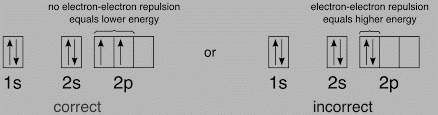
The lowest energy atomic state is the one that maximizes the total spin quantum number for the electrons in the open subshell, according to Hund’s first rule. Before double occupation, the orbitals of the subshell are each occupied singly with electrons of parallel spin.
Figure: 3 Hund’s rule
Starting at the top of the periodic table and working your way down the rows from left to right, write the row number, block letter, and the number of squares in each block’s section until you reach the desired element. Write 1s2 2s2 2p6 3s2 3p3 for the electron configuration of phosphorus (P), which is in the third row, p-block, third element in that block. Check your work by adding the electron numbers to see if they equal the element’s atomic number; for instance, 2+2+6+2+3=15, which is the atomic number of phosphorus.
Electron configurations are written using three methods:
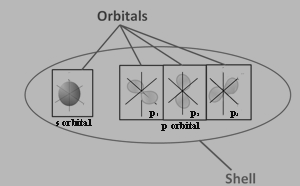
An electron shell is the region of an atom that surrounds the atomic nucleus on the outside. It’s a collection of atomic orbitals with the same n-th main quantum number. One or more electron subshells, or sublevels, exist in electron shells.
A subdivision of electron shells separated by electron orbitals is called a subshell. In an electron configuration, subshells are labelled s, p, d, and f.
The number of electrons, as well as the orbitals. The number and letter indicate the energy level and orbital, respectively, and the superscript number indicates how many electrons are in that orbital.
Figure: 4
The distribution of electrons in an element’s atomic orbitals is described by its electron configuration.
The electron configuration is used to represent an atom that has discharged into a cation or anion by compensating for the loss or gain of electrons in succeeding orbitals. In both inorganic and organic chemistry, the most common application of electron configurations is the reduction of chemical characteristics. In effect, electron configurations, in combination with a simplified version of molecular orbital theory, have evolved into the modern counterpart of the valence notion, which describes the number and type of chemical bonds that an atom is likely to make.


 Profile
 Settings
 Refer your friends
 Sign out