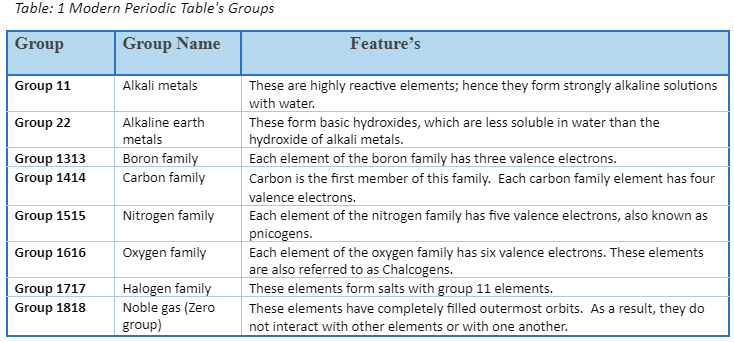
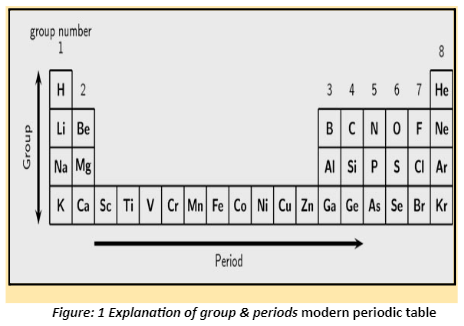
The structure that results from examining the order and similarity of chemical components is known as a periodic system of chemical elements. A periodic table is a representation of the periodic system in another space, usually bi-dimensional. The observed oscillation of various chemical element properties as a function of the atomic number Z is referred to as periodic law.
For chemical elements, there is no single periodic system because they are dependent on the considered elements as well as the establishment of similarity and order. Similarly, the periodic law’s intended universality to all properties of chemical elements does not hold, because some qualities do not oscillate with Z.
Mendeleev’s periodic law and periodic table were used to create the contemporary periodic table. Mendeleev developed his periodic table in the late 18th century.
The modern periodic table, also known as the long version, is based on periodic law. The table is a list of elements arranged in ascending order of their atomic numbers. The periodic table in its current form is known as the modern periodic table. It has 18 vertical columns and seven horizontal rows. The chemical elements are ordered in order of increasing atomic number, or the number of protons in the nucleus of an atom, which corresponds to increasing atomic mass from left to right and top to bottom.
The physical and chemical properties of elements are periodic functions of their atomic numbers, according to the modern periodic law. Scientists arranged elements in ascending order of atomic number from left to right across each row. And it was discovered that elements with comparable qualities recur at regular intervals.
The modern periodic table, often known as the long version, is based on the modern periodic law. The table is a list of elements arranged in ascending order of their atomic numbers. The current periodic table is referred to as the modern periodic table. It has 18 vertical columns and seven horizontal rows.
Dmitri Mendeleev, a Russian chemist, created the framework for the modern periodic table in 1869, leaving gaps for elements yet to be discovered. If, after arranging the elements according to their atomic weight, he discovered that they did not fit into the group, he would rearrange them.
The periodic table is significant because it is organised to provide a wealth of information about elements and their relationships to one another in a single, easy-to-access reference. The table can be used to predict the properties of elements.


 Profile
 Settings
 Refer your friends
 Sign out