As an alternative to element groups, Charles Janet proposed the concept of element blocks (along with helix and left-step periodic tables).
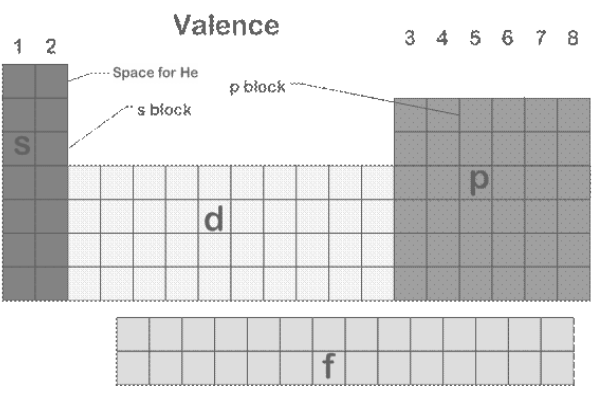
s, p, d, and f are the element blocks. The valence electron orbital determines them. The periodic table divides the elements into blocks depending on their valence electron orbitals.
The four periodic table blocks are used to create the main group (s- and p-blocks), transition metal (d-block), and inner transition metal (f-block) elements. The main group, transition metal, and inner transition metal elements are determined by element blocks.
A periodic table block is a group of elements linked by the atomic orbitals in which their valence electrons or vacancies reside. Charles Janet is thought to have coined the word. The s-block, p-block, d-block, and f-block are all named for the orbitals they represent. The block designations (s, p, d, and f) come from the spectroscopic nomenclature for an electron’s azimuthal quantum number value: sharp, principal, diffuse, or fundamental. Following notations are in alphabetical order, as g, h, and so on, despite the fact that elements that would belong in such blocks have yet to be discovered.
Figure:1 Periodic table blocks
Transition metals are referred to as d-block elements (groups 3-12). d-block elements have qualities that are similar to both highly reactive electropositive s-block elements and more electronegative p-block elements. It is for this reason that they are referred to as “transition” metals.
They’re called “d-block elements, because their valence electrons are in one or more d-orbitals, they are referred to as “d-block elements” (but not in any p-orbitals)
The alkali metals and alkaline earth metals, often known as groups 1 and 2, are part of the s-block in the periodic table of elements. The s block also includes helium. The s orbital is filled with the primary quantum number “n.” The s orbital can only hold a maximum of two electrons at any given moment.
s-subshell contains only one s-orbital, according to Pauli’s principle, an s-block element can only host two electrons with opposite spins. Group I (or IA) and group 2 are the two groups (or IIA).
The p-block is the part of the periodic table that contains columns IIIA through VIIIA but not helium. The p-block consists of 35 elements that all have valence electrons in the p orbital. The p-block elements are a group of elements with a variety of properties.
The valence electrons in the s-block and p-block elements are in an orbital s or p, respectively. To highlight them from the transformation sequence and internal transformation, these are often referred to as Standard Components.
In two important ways, the initial member of the p block elements differs from other elements:
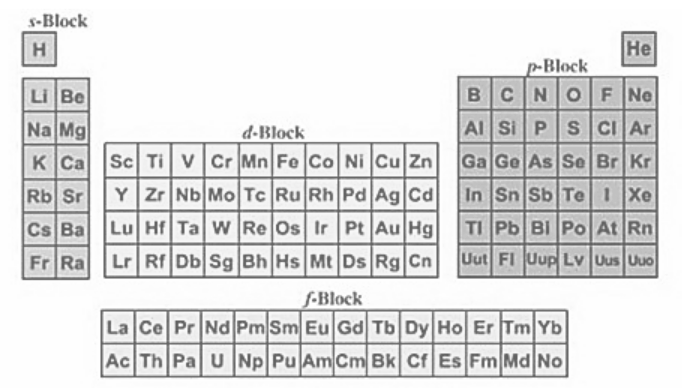
Figure:2 s,p,d,f Elements blocks
The periodic table, often known as the periodic table of (chemical) elements is a representation of the chemical elements in a table format. It’s a chemistry icon that’s often used in chemistry, physics, and other sciences. It’s a visual illustration of the periodic law, which states that chemical elements’ properties are correlated with their atomic numbers in a predictable way. The table is divided into four sections, each about rectangular in shape. The table’s rows are referred to as periods, while the columns are referred to as groups. Chemical characteristics of elements in the same column of the periodic table are comparable. A periodic table block is a collection of elements linked by their atomic orbitals, which contain their valence electrons or vacancies. Charles Janet is thought to have coined the phrase. The s-block, p-block, d-block, and f-block are all named for the orbitals they represent.


 Profile
 Settings
 Refer your friends
 Sign out