Ctenophores (Greek for “comb-bearers”) feature eight “comb rows” of fused cilia arrayed along the sides of the animal, which can be seen clearly in these photos along the red lines. Ctenophores are propelled through the water by cilia that beat in unison. Some animals move by flapping their lobes or by undulating their bodies. Many ctenophores have two lengthy tentacles, however, some are completely devoid of tentacles.
Ctenophores are voracious predators known as comb jellies, sea gooseberries, sea walnuts, or Venus’s girdles. They lack stinging cells, unlike cnidarians, with whom they share numerous superficial similarities. Ctenophores, on the other hand, have sticky cells called colloblasts that help them catch prey. Special cilia in the mouth are utilized by a few species to bite gelatinous prey.
The outer epidermis and inner gastrodermis are two layers of epithelial tissue that makeup ctenophore bodies. The mesoglea, a jelly-like layer of mesenchymal tissue, is sandwiched between these. True muscle cells are located in the mesenchyme and are grouped in longitudinal and radial fibers, providing the majority of body support and assisting in feeding motions. The exterior body of all comb jelly species bears eight plates of long, fused cilia, known as “ctenes,” at some time during their life cycle (typically at all stages). These ciliary bands are the principal mechanism of motility, and an apical sensory organ containing a calcareous statolith coordinates their beating.
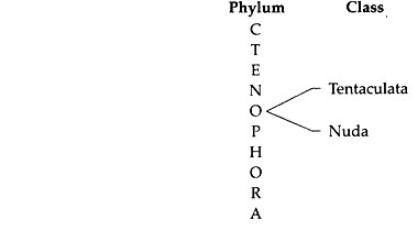
The Ctenophora Phylum is separated into two classes, as listed below:
They have two tentacles with specialized sheaths and a tiny stomodaeum that can retract.
The following are some of the economic and ecological implications of the Phylum Ctenophora:
Phylum Ctenophora is a marine species that do not live in freshwater. They are mainly found at the ocean’s surface or in deep water. This species’ organisms are bi-radial symmetrical. Humans are unfamiliar with the animals in this Phylum.
Sea Walnut, Sea Gooseberry, Venus Girdle, and other animals found in this Phylum are examples of the animals found in this Phylum. Ctenophores manage the plankton population underwater because they reproduce quickly and are good predators.


 Profile
 Settings
 Refer your friends
 Sign out