Trade discount definition indicates a price reduction that a manufacturer or wholesaler offers to a wholesaler or retailer when they purchase a product or group of products from the manufacturer or wholesaler. In other words, a trade discount is a percentage reduction in the list price of a product that a manufacturer is willing to offer to wholesalers or retailers.
Product catalogues are typically produced by manufacturers and wholesalers for use by customers and vendors to place orders for their products. The prices listed in catalogues are referred to as list prices or manufacturers’ suggested retail prices, depending on who you ask (MSRP). Other businesses within the industry that make use of the manufacturer’s products rarely pay the list price for them. Instead, they negotiate lower prices with the manufacturer. Instead, the manufacturer offers a discount on each purchase or a percentage of the list price to the wholesaler or retailer.
It is typically documented in the purchase or sales book, but it is not entered into the ledger accounts, and there is no separate journal entry to reflect this. But when the trade is allowed then it shall be recorded as an expense. However, the following is an example of how a purchase is accounted for in the case of a trade discount.
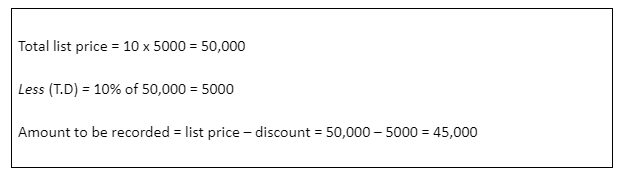
For this example, let us assume that 10 cabinets are acquired from Apex Pvt Ltd. at a list price of Rs. 5000 per item and that a 10 percent discount (trade) is permitted. The following is how the transaction will be recorded in the accounting system:
According to the GST regulations, there will be no distinction between trade discounts and cash discounts. Whenever a discount is mentioned on the face of an invoice, the discount may be deducted from the taxable value of the items that have been supplied.
Even if the discount is not explicitly stated on the invoice, the discount may still be decreased if the following conditions are met:
Manufacturers’ trade discounts assist both manufacturers and retailers/wholesalers. From a manufacturer’s perspective, it increases sales volume and thus profitability. Bulk sales also prevent manufacturers from stockpiling products in their warehouses. It also assists retailers/wholesalers. Conversely, retailers/wholesalers profit handsomely from bulk purchases. They can also give cash discounts to final customers, which helps build client loyalty.


 Profile
 Settings
 Refer your friends
 Sign out