Students think and process information in a variety of ways. Some believe in words and are verbal thinkers. For example, they prefer to explain pictures and diagrams verbally and in writing. Other kids are visual thinkers who approach the subject matter through visual representation. Visual reasoning enables students to solve problems by analysing, processing and interpreting visual data.
Visual reasoning is the ability to assess, comprehend, and conceptually manage visual information to resolve problems. Visual reasoning is critical in educational contexts and various real-world scenarios. For example, a mixture of verbal, analytical, and visual analysis is required to interpret data presented in charts, graphs, and maps.
Identifying and manipulating visual items is everyday testing activity. Identifying and manipulating visual patterns is essential for effectively answering these questions. For example, you might see a pattern and ask students to determine what the following form should be. Although written language is not required to solve such a problem, students must apply visual and spatial skills.
As part of visual reasoning, spatial thinking requires students to comprehend the position and shape of objects and recall their relative places in their minds. In addition, students must envision or visualise how items are used mentally to create new spatial relations.
In visual reasoning, students are given a number of images and illustrations and asked to identify the pattern. The questions might range from identifying the incorrect image in the series to selecting the options that complete the visual sequence, but we must always identify the pattern.
There are hundreds of patterns, but here are a few that frequently occur in visual reasoning questions:
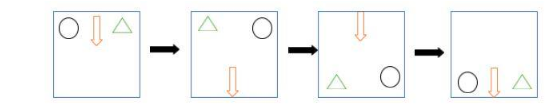
To solve these questions, we have to determine the movement patterns of an illustration’s elements to predict what will occur next in the series of events.

This type of question requires us to recognise the rotational patterns of individual elements in artwork to forecast the next stage in their movement.
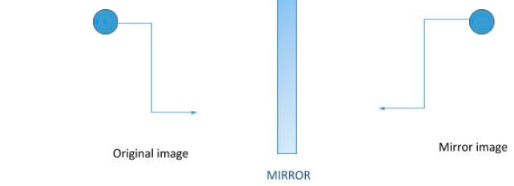
The mirror image is formed by placing an object in front of a mirror, or in more straightforward terms, the object’s mirror reflection.
Thus, one technique to recognise a mirror image is to check for the element/object/lateral illustration’s inversion: The left side of the image becomes the right side of the reflections and the right-hand side of the imagery becomes the left-hand side of the picture.
As shown above, the top and bottom portions of the image remain unchanged in a mirror image.
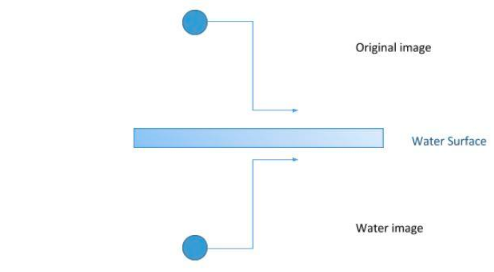
The term “water image” refers to an object’s reflection on the water’s surface. So when you look at water images, the top portion of the object is at the bottom of that too, and it is also at the top of it.
As shown above, the left and right sides of the image remain unchanged in a mirror image.
Problem involving the odd man out
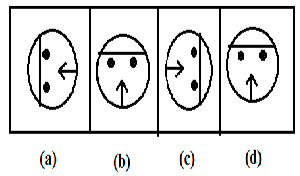
Example1. Select the figure that is different from the others.
Sol. (d) The figures are arranged in a series. Each step flips the entire figure 90° clockwise. Fig. (d) does not belong in the sequence because it duplicates fig (b). As a result, fig. (d) is the correct answer.
Problem with Figure Counting
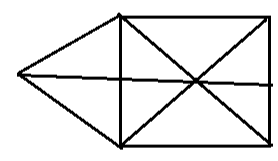
Example2. Determine the number of triangles in the following diagram?
(a) 16 (b) 17 (c) 18 (d) 15
Sol. (b)
The triangles are:
∆ABF: ∆AGB: ∆AGF: ∆BFC;
∆BCE: ∆CEF: ∆BFE: ∆HBC;
∆HCE: ∆HEF: ∆HBF: ∆BGH;
∆FGH: ∆HCD:∆HDE:∆AFH;
∆ABH:
The Significance of Visual Reasoning
Visual intelligence assesses the capacity to interpret visual information and think about physical and mental representations. As a result, those with solid visual skills have an easier way of comprehending and communicating information to others. In addition, visualisation skills impact how well you recognise patterns and extract data. Visualisation also helps to build associations between data, which, in turn, helps in boosting long-term memory.
Students can solve problems by remembering the placement of items and patterns in their minds. Therefore, providing children with the opportunity to develop their spatial reasoning skills is essential in the classroom and helps them do routine work successfully.
Reasoning is a vital part of the majority of Competitive Exams. It demonstrates a person’s capacity for analysis and decision-making. As with other skills, regular practice may enhance and improve reasoning. Visual-spatial skills are crucial in day-to-day operations, and many vocations and career progression require these skills and solid visual memories. For example, even simple tasks such as carrying luggage for a journey need a person to visualise how to organise objects in a case to maximise storage capacity; this involves spatial thinking.