Paper folding is an age-old technique used to teach children the art of folding paper to create unique shapes. The main objective of this paper folding craft is to increase memory, concentration, mental ability and eye-hand coordination among children from a very early age. This activity involves the usage of multi-sensory organs. This practice of this method calms the brain and reduces frustration. Through paper folding, various concepts of mathematics like geometry and fractions are learnt; it also develops thinking skills.
In countries like China and Japan, this paper folding activity is included as part of their curriculum. In Japan this is known as Origami; it is the traditional way to fold paper to create unique shapes. The word Origami is derived from two Japanese words “Oru” means “to fold” and “Kami” means “paper”, it means “the art of folding paper”.
Paper folding activity is now included in the form of analytical questions in many competitive exams to check the mental ability and reasoning power of aspirants. Solving this type of question makes one active and also efficient.
Paper folding activity is taught to improve problem-solving skills. This makes people learn how to convert a piece of paper into an object just by folding it without using any tools. It improves their analytical skills and creativity.
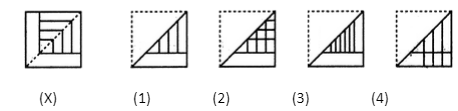
In non-verbal reasoning, the paper folding technique is introduced to test problem-solving and analytical skills. This improves the ability of the person to think in critical situations and interpret visual data and solve questions using reasoning. The paper folding activity includes various patterns, sequences, shapes and calculations. We can see the following mental ability question on paper folding, as a reference to understand the content more clearly:
Question:
A.1 B.2 C. 3 D. 4
Explanation:
Paper folding questions are being asked in many competitive exams. These questions are calculative, analytical and tricky. It needs complete concentration and thinking efficiency to solve these problems. It requires a clear idea about the question to analyse the answer. Let’s learn how to understand the paper folding question properly:
Every entrance exam in today’s competitive world has reasoning and mental ability questions. Paper folding questions occupy a major part of this section. If practised correctly, paper folding questions can be easy and time-saving for you.
The introduction of paper folding in children’s curriculum from school develops their mental health. It helps to keep children active, occupied and away from gadgets. It helps them learn the art of giving their thoughts form and shape.
Believe it or not, paper folding forms the base for the understanding of many subjects. It is quite interesting as a small piece of paper is turned into various interesting objects without the usage of scissors, glue or any other tool.
Paper folding is not a new technique. It’s an ancient Japanese technique used to strengthen the brains of people. It not only improves the memory of students but also inculcates patience and attention skills in them. The paper folding art seems to be a simple task but requires the integration of many key skills. We see paper folding in and around us in many forms; the simplest paper boat to wrap a gift includes paper folding. This helps in improving the overall ability and critical problem analysis power of a child. So, all the educationalists around the world are suggesting that the introduction of reasoning and mental ability concepts like paper folding be introduced from early childhood.


 Profile
 Settings
 Refer your friends
 Sign out