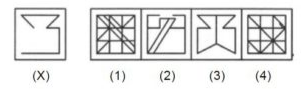
Embedded figures completely contain the first. An embedded figure question has a hidden figure within one of the four options. In such questions, all options are similar and confusing. The candidate must be careful when answering such questions. With practice, we can master these figures.
The Embedded Figures Test aims to identify a simple form embedded in a more complex figure. This test can assess social behaviour, analytical style, and problem-solving approach.
Find X in the remaining four images. So which of the four images has the figure X in it?
You have to consider the orientation. Changing the orientation of one of the two figures may be necessary if X does not fit a particular option.
Figure X is missing from (2) in the above example or (4). Even though (3) appears to contain X, you’ll find out that even (3) isn’t the correct answer when you look at the bottom. This only leaves (1). Taking X and putting it in (1) does not affect either two figures. As a result, the proper answer is (1).
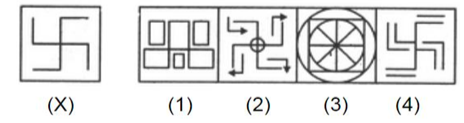
Which figure contains X?
Option (2) has an incorrect orientation if you look at it. In (4), the figure split at points despite the correct orientation and thus is not the right option. Also, (1) lacks orientation and symmetry, which is incorrect. As a result, option (3) is the right answer. We can plot Figure X on (3) without changing the other two.
The following are five figures. X is the name of one of them. Find an image that does not change when overlapping with X?
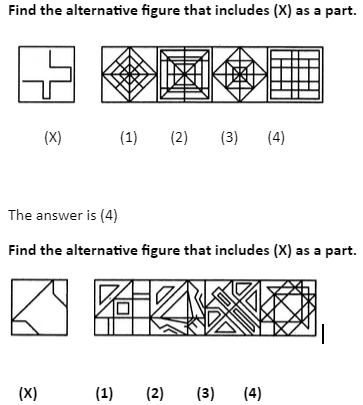
Find the alternative figure that includes (X) as a part.
The answer is (4)
Formation of Figures
When we create a geometric form of a specific shape using pieces of different designs, the process is Figure Formation.
Exams require a lot of time management. You must finish your exam in the time allotted. However, in a competitive exam, the questions assess your ability to perform calculations in a given time. It’s all about how quickly students can solve a question paper, and it is why so many students could not complete their assignments in the time allotted. Non-Verbal Reasoning (NVR) tips will help you pass government, bank, and other exam questions quickly and easily.
Type 1
In these questions, the candidate must choose an answer choice figure that can form by arranging the pieces in the question figure.
Type 2
It is the opposite of a problem of type 1. In this type of question, a candidate must form a question figure from pieces of one of the answer choices and then find the correct answer figure. Pieces of boundary lines that appear in answer figures count as part of forming the question figure. A deep analysis of the question and answer statistics is necessary for these questions.
Type 3
This type of question requires you to join three figures from a collection of various designs to form an equilateral (or isosceles, or other types of the triangle). A candidate must select the correct combination of figures from the given options.
These questions necessitate a thorough examination of the various elements (designs) present in the figure to form and spatial analysis of the figure to form.
Type 4
An answer to this type of question involves joining three figures from a group of various designs. The candidate must select the correct number combination from the given options.
We can use the number of elements in the group of figures or the number of lines in the figures to classify them. We can also classify Figures by even or odd numbers of lines or elements or by the number of lines or elements.
The most common classification. Similar figures are really clockwise or anticlockwise rotated versions of the same figure. We can’t get the figure different from the others by rotating the others.
We can use the number of elements or lines in a figure group to classify it. We can also classify figures by odd or even numbers of lines or elements, and we can use the number of lines and elements to classify them.
This form of classification divides figures into equal or unequal sections or parts.
The group’s orientation, shape, angle, and presentation are all the same except for one figure.
In this classification, the odd figure has no relation to the other figure elements. This relationship depends on element shape, inversion, etc.
A figure consists of two or more elements, which may be inside other elements and some outside. We apply this consideration to classify elements from a group.
Embedded figure questions contain a single figure hidden within one of the given options. In such questions, all options are confusing. As a result, children must have a clear understanding when answering such questions, and with practice, children can learn these figures. To find the correct option figure, we must first understand the question figure’s form.
The Embedded Figures Test (EFT) is the best option for testing your children’s cognitive abilities and style. We can use this test to examine your analytical style, social behaviour, problem-solving style, and defence mechanism. Based on the field dependence-independence model, embedded figure tests can indicate unique cognitive styles in individuals, where field independence is the capacity to detect shapes in a larger, more complicated image.


 Profile
 Settings
 Refer your friends
 Sign out