The halogens are the elements belonging to the Group 7 of the periodic table. The halogen family comprises fluorine, chlorine, bromine, iodine, astatine and tennessine. The halogens have a valency of 1 due to a free space to accept electrons. They are immensely electronegative due to the vacancy in the outer shell. Halogens tend to react within themselves to form interhalogen compounds with covalent bonds in between them.
One such compound is bromine pentafluoride. The hybridisation of bromine pentafluoride forms a hybrid orbital of different energy and varied shape, like any other hybridisation process of atoms.
Hybridisation generally means to intermix two things, which results in a novel product called the hybrid.
In chemistry, hybridisation refers to the idea of the orbitals of two atoms mixing to form a novel orbital that has different energy, shape, and properties from the parental elements.
Halogens take their place in the periodic table under group 7. Their name refers to their property of forming salts. The halogen family comprises F, Cl, Br, I, At, and maybe Ts.
The halogens possess some common and general physical and chemical properties. They usually exist as a homonuclear diatom.
The first halogen, fluorine, with an atomic number of 9 of the group, has 2 orbits in its atom of the electronic configuration 2,7.
One extra orbit is added to the atom on moving down the group.
Thus, the size of a halogen increases down the group.
All the halogens possess a free space for the addition of an electron in its valence shell.
Thus, the valency of the halogens is always 1.
Due to the ability to take up one electron in their valence shell, they act electronegative.
Their electronegativity property tends to decrease the group due to their increased size on moving down.
Bromine pentafluoride, BrF5, is an interhalogen compound formed due to a pentavalent bromine atom. The molecule is highly reactive and in vapour form, irritating our skin, eyes and mucous membrane.
Bromine’s atomic number is 35.
It has an electronic configuration of [Ar]4s23d104p5.
The fluorine atomic number is 9.
It has an electronic configuration of [He]2s22p5.
One fluorine atom can accept one pair of electrons from the bromine atom on losing one electron pair from its valence shell.
Thus, five fluorine atoms bond with the pentavalent bromine atom, resulting in a hybridised bromine pentafluoride molecule.
An orbital is a 3D space where the electrons are primarily found in an atom. An orbital can, generally, hold two electrons.
The s orbital is capable of holding 2 electrons.
The p orbital can hold 6 electrons because it is divided into px, py, and pz, each containing two electrons.
The d orbital can hold up to 10 electrons since it is subdivided into dxy, dyz, dxz, dx2-y2 and dz2.
Each orbital holds two electrons; thus, in total, a d orbital holds up to 10 electrons.
An f orbital is capable of holding 14 electrons.
Hybridisation of bromine pentafluoride
The hybridisation of bromine pentafluoride results in an orbital configuration of sp3d2.
The hybridisation results in a square pyramidal shape of the molecule.
Generally the bromine electronic configuration is 1s2 2s2 2p6 3s2 3p6 3d10 4s2 4p5.
But, to attain a pentavalent structure, the atom must have five free electrons.
So, three electrons from the 4p5 shift to the 4d orbital, which results in five lone pairs of electrons.
The shift favours a half-filled configuration of 4p orbital, making it more stable.
It also makes one of the five orbitals of the 4d orbital filled.
Thus, five fluorine atoms can accept one lone pair of electrons bound with the bromine atom.
Thus, their orbitals are mixed through hybridisation, forming the hybrid shape of the molecule.
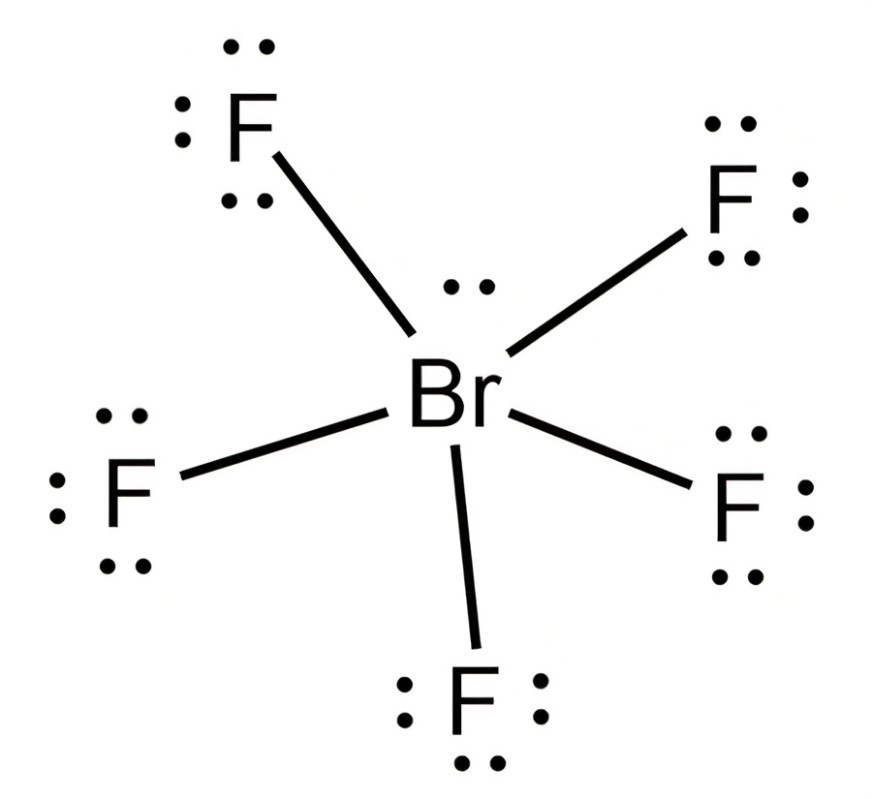
Bromine pentafluoride – square pyramidal structure
On overlapping head-on-head, bromine pentafluoride forms five sigma bromine bonds with fluorines.
In the square pyramidal structure formed due to the hybridisation of fluorine pentafluoride, the angle of the bond formed between the fluorine atoms with the central atom is 90°.
There still exists one lone pair of electrons in the central bromine atom.
Bromine pentafluoride is a colourless liquid that gives off a pungent odour.
It generally acts as an oxidising agent in rocket propellants.
It is involved as one of the oxidising agents in converting uranium to uranium hexafluoride.
It helps in synthesising fluorocarbons.
The hybridisation of Bromine Pentafluoride notes provide all the details on the chemical molecule bromine pentafluoride. It is a hybrid molecule formed due to covalent bonding between the pentavalent bromine and five fluorine atoms, lacking one pair of electrons. It is highly reactive and is used in chemical processes and commercial rocket propellants as oxidisers.
The hybridisation of bromine pentafluoride forms an sp3d2 hybridisation, resulting in a square pyramidal molecular structure. The hybrid molecule has six sigma bonds due to the covalent electron sharing and a bond angle of about 90°. For hybridisation to occur, two electrons from the 4p orbital of bromine shift to its 4d orbital.



 Profile
 Settings
 Refer your friends
 Sign out


