Van der Waals Equation of state helps us assist the behavior of real gas. It is a formula
that determines the distance between two points. It is broadly used in chemistry and
thermodynamics. In 1873 Johannes Van der Waals created this equation. It improves the Ideal
Gas Law as well as anticipates the features of real gasses by defining particles of non-zero
volume regulated by attractive pairwise forces. This is basically an upgraded version of the ideal
gas law. In this article, we have put extra effort into collecting some of the exciting problems regarding Van der Waal’s equation in the end but beginning with the definition of Van der Wall equation and statements.
The Van der Waals equation deals with the effects of molecules interacting in
a gaseous state while extending this to the ideal gas law. The Van der Waals equation, in a way,
can be called the extension of the ideal gas law. According to the ideal gas law, the relationship given below is that for ‘n’ number of moles that are occupied by any gas, in volume ‘V” and at pressure ‘P’ and temperature ‘T’ where the gas constant is denoted by ‘R’:
PV = nRT
The Van der Waals equation can be written in this way:
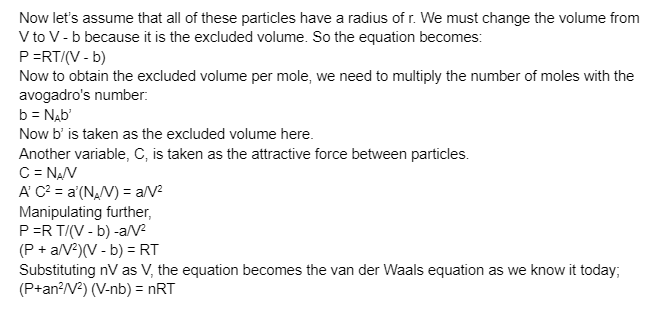
(P+an²/V²) (V-nb) = nRT
So in this equation P, V, R, T, and n stand for pressure, volume, gas constant, temperature, and
moles of gas, respectively. The ‘a’ and ‘b’ stands for constants specific to certain gases. The units of the van der Waals equation for a is atm lit2 mol-2, and the unit for b is liter mol-1.
First, we will calculate the one mole of a gaseous mixture in the ideal gas equation.
P = RT/V
Using the Van der Waals equation, answer the following questions correctly.
1 . The Vand der Waals equation explains the behavioral change of which of the following:
Solution: (a) Real Gases. Van der Waals Equation of state helps us assist the behavior of real gas. This equation can only give accurate answers for the real gasses, which are only above the critical temperature.
2 . The term in the equation of Van der Waals which determines the intramolecular forces is:
Solution: (d) P + a/V² determines the intramolecular forces in the equation of Van der Waals.
3.The term in the equation of Van der Waals which determines the effective volume calculated of non-ideal gases is:
Solution: (b) V – b determines the effective volume calculated of non-ideal gases in the equation of Van der Waals.
4 . What happens to the Van der Waals equation when the pressure is increased drastically?
Solution: (a) (P+an²/V²) (V) = nRT is the right choice because when the pressure increases, the molecules of the gases are forced to come close to each other. By increasing the pressure, the volume of the gases is definitely going to decrease. Hence, we can ignore the effective volume constant b in the equation, using (V – b) as V.
The perfect Gas Law did not explain the behavior of real gasses. The Van der Waals law equation is a modified edition of the best Gas Law. ‘a’ and ‘b’ are named because the constant is specific to every gas. Supporting the talents of the particles, this extra deviation is additionally
used. The values below the critical temperature are accepted within the Van der Waals equation. The Gasses consist of the point masses that undergo flawlessly elastic collisions as stated by the law of ideal gasses. It can analyze the behavior of gas. To conclude, the Van der Waals equation is a thermodynamics equation of state that assumes that fluids are made up of non-zero volume particles that are attracted to each other.



 Profile
 Settings
 Refer your friends
 Sign out