


 Profile
 Settings
 Refer your friends
 Sign out




About NISAR:
![]() Key Features:
Key Features:
- NISAR stands for NASA-ISRO Synthetic Aperture Radar.
- It is the first joint Earth observation satellite between NASA and ISRO placed in a sun-synchronous orbit.
- The satellite weighs 2,392 kg and has a mission life of 5 years.
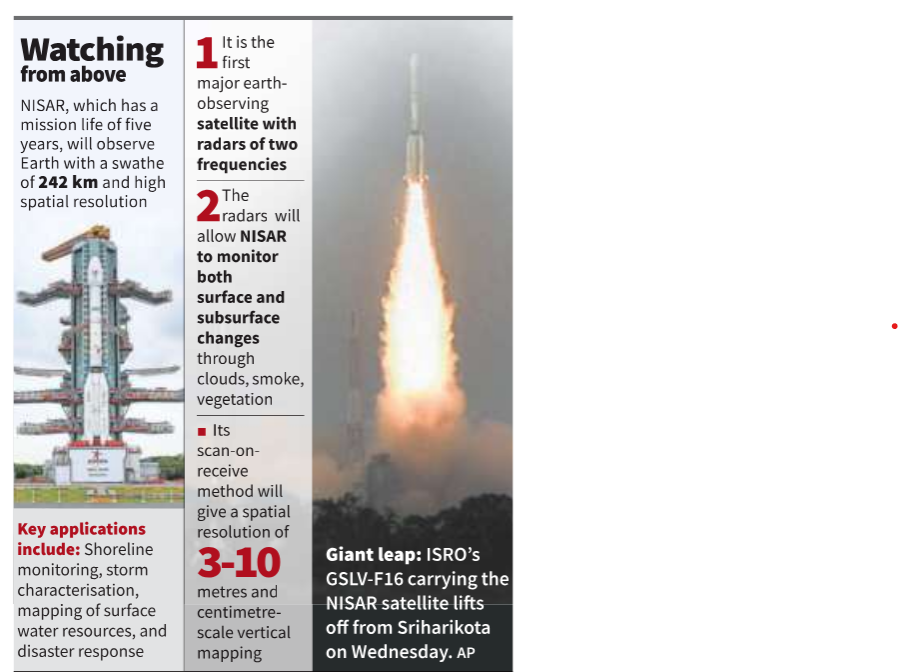
- It uses dual-frequency SAR technology (NASA’s L-band and ISRO’s S-band) to observe Earth with high spatial resolution.
- Observes Earth every 12 days using SweepSAR technology.
- Offers a 242 km swathe for data collection, in all weather, day-and-night conditions.
- Can detect small changes on Earth’s surface like ground deformation, ice movement, and vegetation shifts.
- Disaster management – earthquakes, floods, landslides.
- Agriculture – crop mapping and yield estimation.
- Environmental monitoring – soil moisture, surface water, shorelines, sea ice, and storms.
- Infrastructure surveillance and ship detection.
- NASA (JPL): L-band radar, mesh reflector antenna, engineering payload.
- ISRO: Satellite bus, solar arrays, S-band radar, launch vehicle (GSLV-F16).
- A sun-synchronous orbit (SSO) is a near-polar orbit in which the satellite passes over the same region of the Earth at roughly the same local solar time.
- This provides consistent lighting conditions for imaging, which is ideal for Earth observation missions.
- NISAR’s placement in an SSO allows it to scan the Earth every 12 days, ensuring uniform and repeatable data collection.
- The NISAR satellite, jointly developed by NASA and ISRO, was successfully launched on 30th July 2025 from Sriharikota using the GSLV-F16 rocket, marking the first time a GSLV placed a satellite into a sun-synchronous polar orbit.
